Cold plunge in a bathtub: how to do it
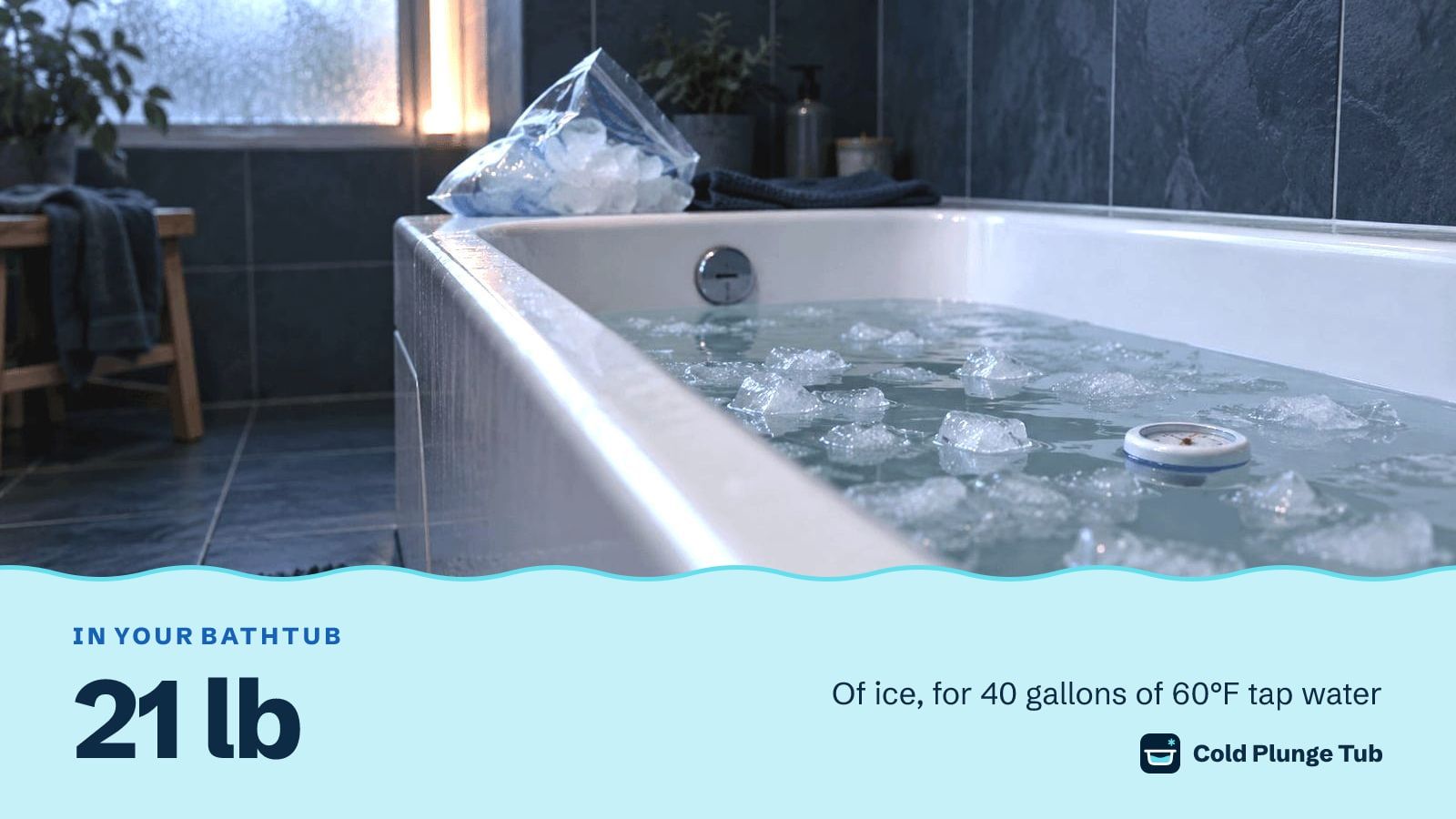
A cold plunge in a bathtub costs only the ice: about 21 lb for 40 gallons of 60°F tap water. The steps, the ice table and the mould warning owners give.
For a bathtub plunge
- Suoimk Floating ice bath thermometer with timerUnder $300See it on Amazon
- AS ColdPlunge AS-AY30042°F statedSee it on Amazon
The short answer
About 21 lb of ice
That turns 40 gallons of 60°F tap water into a 50°F cold plunge in the bathtub you already own. Fill it with cold water, add the ice, check the temperature, get in for a minute or two, then drain it. It costs about $6 a session.
For a bathtub plunge
- Suoimk Floating ice bath thermometer with timerUnder $300See it on Amazon
- AS ColdPlunge AS-AY30042°F statedSee it on Amazon
Can you cold plunge in your bathtub?
Yes. A cold plunge in a bathtub is a bath of cold tap water, usually with ice added, that you sit in for a few minutes. Cleveland Clinic’s sports medicine physician says a tub of cold tap water “can be just low enough on the temperature front to achieve some goals of a cold plunge”, and that people go colder by adding a few large bags of ice. Mayo Clinic Health System makes the same point about a bathtub with cold water and ice.
It is the first of the five routes in the DIY cold plunge tub, and the only one that needs nothing built.
We have not done this ourselves. The steps come from the two medical sources, the ice figures are our maths, and the practical warnings come from twelve threads on the r/coldplunge forum, read on 5 October 2026.
- About $6 A session, in ice
- 15 minutes To fill and add ice
- Nothing to build Difficulty
- 50–59°F The temperature to aim for
The cost is our maths: 21 lb of ice at $3 for a 10 lb bag. The temperature range is Cleveland Clinic’s for beginners.
What you need
- 1×
Your bathtub
Any tub that holds water and drains
Nothing - 1×
Bagged ice, 20 to 50 lb
The table below says how much for your tap
$6 to $15Grocery store - 1×
Suoimk Floating ice bath thermometer with timer
So you know the water is between 50 and 59°F, and not below 40°F
- 1×
Gallon jugs of water, frozen
Optional. Each is 8.34 lb of ice you can refreeze
Your freezer
Total for the buildAbout $6 a sessionOur maths, for 21 lb of ice at $3 a 10 lb bag. Your tap temperature changes it.
The thermometer is the one thing worth buying. Without it you are guessing, and Cleveland Clinic’s advice is to use one “to make sure you’re in a safe zone”.
How to cold plunge in a bathtub
- Measure your cold tap. Run it for a minute and hold the thermometer in the stream. If it reads in the 50s, you may need no ice at all.
- Fill the tub with cold water only. Stop a few inches below the overflow, because the level rises when you get in.
- Add the ice and wait. Stir it, then give it time to melt in. An owner on r/coldplunge says a big drop, from 60°F down to the 40s, takes about an hour.
- Check the temperature. Aim for 50 to 59°F. Stir before you read it, since the water is colder next to the ice.
- Get in for one to two minutes. Lie back to get your shoulders under. Get out if you feel lightheaded or anything beyond cold.
- Drain it straight away. Then wipe the tub down and run the fan.
The times in step five are Cleveland Clinic’s: a minute or two for beginners, and never longer than five. Its lowest safe temperature is 40°F. Our guide to cold plunge temperature goes through the range.
How much ice a bathtub needs
Work from the water you put in. A bathtub holds far less than a cold plunge tub, so it needs far less ice.
| Tap water | 30 gallons | 40 gallons | 50 gallons |
|---|---|---|---|
| 55°F | 8 lb | 10 lb | 13 lb |
| 60°F | 15 lb | 21 lb | 26 lb |
| 65°F | 23 lb | 31 lb | 39 lb |
| 70°F | 31 lb | 41 lb | 51 lb |
| 75°F | 39 lb | 51 lb | 64 lb |
To find your gallons, time the cold tap filling a one-gallon jug, then time how long the tub takes to fill. A tap that fills the jug in 12 seconds and the tub in 8 minutes has put in 40 gallons.
Warm tap water is where a bathtub plunge gets hard. An owner in Los Angeles, where the tap runs at 65 to 70°F, says a fridge’s whole ice bucket cooled the tub by only 4 to 5 degrees. The table agrees: from 70°F you need 41 lb for 40 gallons. The sum behind it is in how much ice an ice bath needs.
The mould warning, and what to do about it
This is the one risk owners raise again and again, and it is about leaving cold water in the tub, not about plunging in it.
A built-in bathtub is thin and has no insulation. Fill it with ice water and the outside of the shell gets cold enough for the air behind the panel to condense on it. One owner describes the water dripping onto the subfloor and framing, where repeated wetting grows mould you cannot see.
Owners on r/coldplunge agree on the fix: drain it after every plunge. Several say that a tub filled, used and emptied within the hour causes no trouble, and one has plunged in a bathtub this way for a few years. The problems they describe come from keeping a tub full and chilled for days.
A freestanding tub with air around it is safer, because you can see and wipe any condensation.
Mistakes to avoid
- Leaving the water in. See above. A bathtub is a one-session cold plunge.
- Filling to the brim. One owner covers the overflow drain to gain a couple of inches of depth, and warns that it is then easy to flood the floor getting in.
- Expecting to be covered. A standard bathtub is shallow. One owner could not get their chest under. Lie back with your knees up, or accept that this is a trial run.
- Skipping the thermometer. Ice water can go below 40°F, which Cleveland Clinic says to avoid.
- Getting in before the ice has melted in. The water near the ice is colder than the rest, so your reading is wrong until you stir.
Putting a chiller on a bathtub
You can, and makers sell for it. TURBRO says its FrostCore F85 works with a bathtub, and both AS ColdPlunge chillers come with a submersible pump for the purpose. The chiller sits beside the tub with one hose in and one out. Our notes are in a chiller for a bathtub.
Owners are split on whether you should. One fills the tub the night before, runs the chiller overnight, plunges in the morning and drains it. Another measured just over three hours to reach about 48°F. A third has run a converted bathtub daily for a year and sees condensation only below 42°F, and keeps it above that.
Against that, a chiller makes you want to keep the water, and keeping the water is what causes the mould. It also puts its heat into your bathroom. If you are ready to buy a chiller, a tub with a lid and insulation is the better thing to connect it to.
When to stop using the bathtub
A bathtub plunge costs about $6 a session in ice, which at three sessions a week is about $980 a year by our maths. That is more than a soft tub and a small chiller together.
Stay with the bathtub while you find out whether you like cold plunging. Once you are doing it most weeks, a pod pays for itself in ice and keeps the water for more than one session. The cheap ones are in cheap cold plunge tubs, and the full costs are in what a cold plunge costs.
Common questions
Is a cold bath as good as a cold plunge?
They are the same thing if the water is as cold and covers as much of you. A bathtub is shallower, so less of your body is under.
Is a cold shower the same as a cold plunge in a bathtub?
No. A shower is only as cold as your tap and wets part of you at a time. Owners who have done both say the shower feels harder and the bath does more.
Can I use ice packs or frozen bottles?
Yes. A frozen gallon jug is 8.34 lb of ice. For 21 lb you need three, and they take longer to give up their cold than loose ice.
Will ice water damage my bathtub?
Not in one session. The risk owners describe is condensation behind a built-in tub that is kept cold for days.