DIY cold plunge tub: parts, cost and steps
A DIY cold plunge tub built from a stock tank, a chiller, a pump and a filter costs about $1,000 to $1,300. The parts list, the steps and what owners got wrong.
Chillers with the pump built in
Coldest temperature the maker states
All our chiller picksThe short answer
$1,000 to $1,300
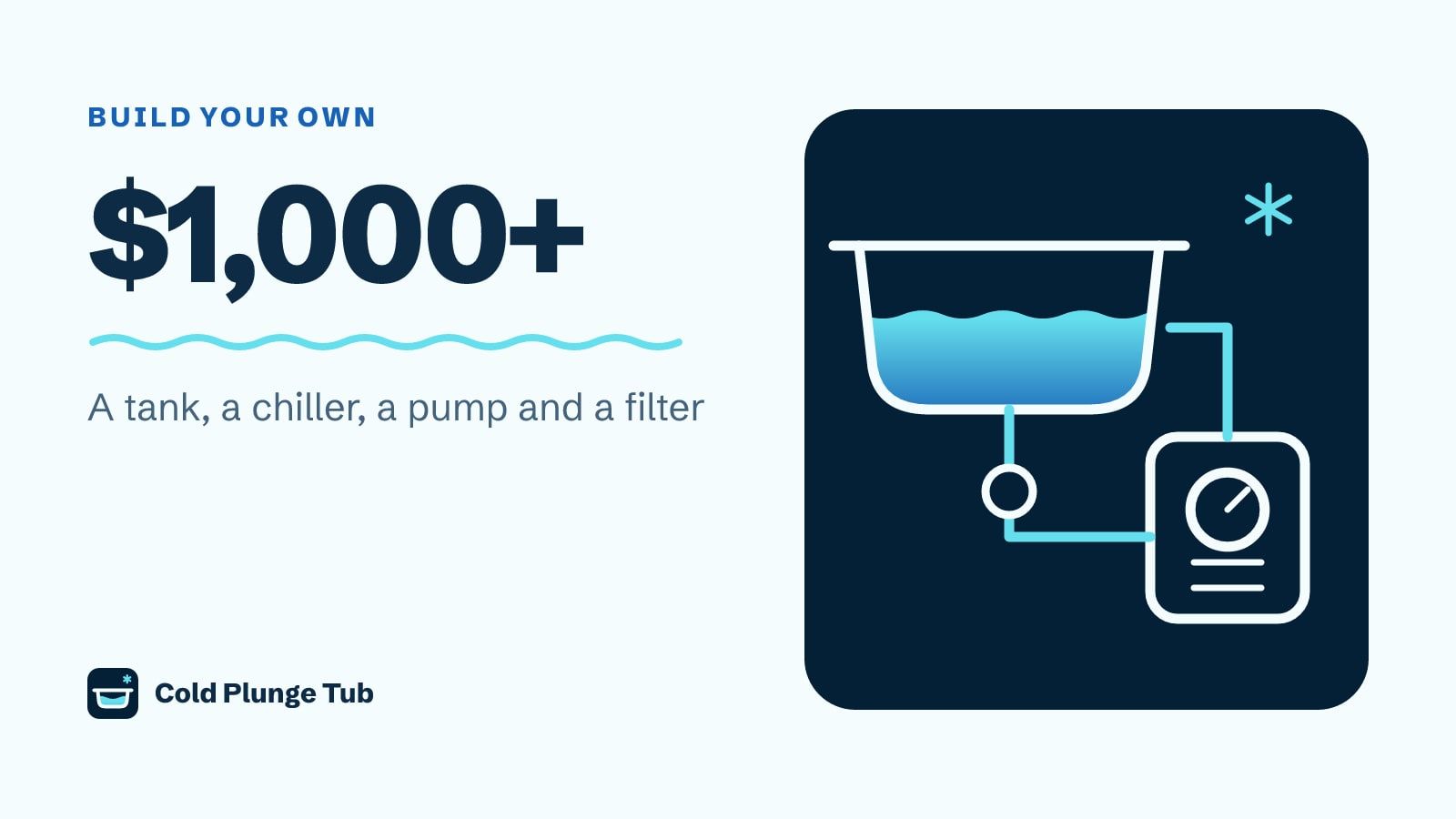
That is what a DIY cold plunge tub costs when it is built the way most owners build one: a 100 gallon stock tank, a small water chiller, a pump, a filter and insulation. It takes a weekend or more, and owners report holding 38 to 55°F with it.
Chillers with the pump built in
Coldest temperature the maker states
All our chiller picksWhat a DIY cold plunge tub is
A DIY cold plunge is a tub you plumb yourself: water leaves the tub, passes through a pump, a filter and a chiller, and returns cold. The parts are ordinary. The tank is a farm stock tank, the pump comes from the pond trade, and the filter is a whole-house housing from a hardware store.
We have not built one. This page is assembled from twelve build threads on the r/coldplunge forum, read in October 2026, and the costs are what those owners say they paid.
- $1,000–$1,300 Total cost
- A weekend or more Build time
- 38–55°F Water temperature owners report
- 100 gal The usual tank
Owner reports from r/coldplunge. The cost is one owner’s itemised list, plus his insulation.
Five ways to build a homemade cold plunge
The build below is the fourth row. The others are worth knowing before you spend.
| Route | What it costs | Cooling | Effort | Good for |
|---|---|---|---|---|
| Bathtub and ice | The ice | Ice | None | Finding out if you like it |
| Stock tank and ice | About $150 for the tank | Ice | An afternoon | Cool climates, winter |
| Soft pod and a chiller | About $730 as a kit | Chiller | An afternoon | Renters, small spaces |
| Stock tank, chiller, pump, filter | $1,000–$1,300 | Chiller | A weekend or more | A permanent outdoor setup |
| Chest freezer conversion | About $650 by one owner’s count | The freezer itself | Sealing takes days to cure | People comfortable sealing and wiring |
A chest freezer was built to hold frozen food, not water and a person. If you go that way, seal every seam, plug it into a GFCI outlet, and unplug it before you get in.
DIY ice bath parts list
- 1×
Rubbermaid Commercial Products Brute Stock Tank, 100 gallon
The tub: 100 gallons. Owners paid about $150 at farm supply stores, so compare before you buy
- 1×
Active Aqua Chiller with Power Boost, 1/2 HP (AACH50HP)
The largest cost. A bare chiller: it needs the pump and filter below. Owners report paying $600 to $950 for theirs
- 1×
Danner Pondmaster Pond-Mag 950 GPH (02720)
Moves the water through the filter and chiller. Owners paid about $121
- 1×
GE Whole House Water Filtration System (housing)
Catches hair and grit before the chiller. Buy cartridges with it
- 1×
Outus 3/4 in PVC bulkhead fitting, 2 pieces
Two fittings: one outlet low on the tank, one return higher up
- 1×
3/4 in tubing, 6 ft, with barbs and clamps
Buy the barbs to match the tubing
$35Hardware store - 1×
Lamudo Ozone generator with Venturi injector
Optional. Sanitises the water. A small brand, chosen on its listing alone
- 1×
Suoimk Floating ice bath thermometer with timer
A second reading to check the chiller against
- 1×
Foam board, spray foam and framing timber
Insulation and a frame to hold it
$200Hardware store - 1×
GFCI outlet or adapter
Not optional. Everything plugs into it
Hardware store
Total for the build$1,000–$1,300What owners on r/coldplunge report paying in 2025 and 2026. We have not built this, and prices vary by shop.
Parts with a button are on Amazon, whose prices we don’t print. The tubing and the insulation come from a hardware store, and the tank is often cheaper at a farm supply store. The total is one owner’s itemised list. Two other owners put their totals at about $1,000 with a smaller parts list and about $1,600 with a 1.5 HP chiller.
How to build it
- Set the tank on level ground. Compact the soil, add gravel, and lay pavers. A full 100 gallon tank weighs over 830 lb.
- Fit the two bulkheads. Drill for an outlet low on the tank and a return higher up. Seal each with a bead of silicone as well as its gasket.
- Mount the pump below the outlet. A pump pushes water and does not pull it, so it has to sit lower than the hole it draws from.
- Plumb the loop. Tank, pump, filter, chiller, and back to the tank. Put the filter after the pump and before the chiller.
- Add ozone, if you want it. The injector goes in the line and the generator runs on a timer.
- Insulate. Build a frame, pack it with foam board and spray foam, and make an insulated lid.
- Plug into a GFCI outlet, fill, and check for leaks before you switch the chiller on.
- Set the chiller to 50–55°F and check the water with a second thermometer.
Step 6 is the one people skip and regret. An owner in central Florida ran a 1/3 HP chiller on a lightly insulated stock tank and found it running around the clock to hold 48°F. An owner in Phoenix, with a framed and insulated 100 gallon tank, held 38°F through a record summer.
Cold plunge pump and filter
The pump and filter are where most first builds go wrong, so they get their own section.
The pump. Owners on r/coldplunge use Danner Mag-Drive pond pumps more than any other, in sizes from 700 to 1,800 gallons an hour. Retailers list the two most common like this.
| Danner 950 pump | Danner 1200 pump | |
|---|---|---|
| Flow | 950 gal/hour | 1,200 gal/hour |
| Lifts water | 12 ft 10 in | 13 ft 6 in |
| Inlet and outlet | 3/4 in | 3/4 in |
Either suits a 100 gallon tank with a 1/3 or 1/2 HP chiller. Check the flow your chiller asks for, and match the pump to it: the Active Aqua 1/2 HP calls for 800 to 1,600 gallons an hour, by its maker’s spec.
A submersible pump is quieter and needs less hose. One owner who uses one makes a point of switching the power off before getting in.
The filter. A whole-house sediment housing with a 3/4 in inlet is the standard choice. One owner changes the cartridge monthly. Several say that when a DIY plunge stops cooling, the cause is nearly always a clogged filter slowing the flow, not the chiller.
The water. One owner runs ozone for an hour a day and adds hydrogen peroxide, and reports clean water for more than four months. A sealed lid matters as much, because sunlight and leaves are what turn the water.
The shortcut: a chiller with the pump built in
You can skip the pump, the filter housing and most of the plumbing by buying a chiller that contains them. It costs less in parts and time. You give up the freedom to replace one part when it fails.
Four of our five chiller picks come with their own pump and filter. They are compared in the best cold plunge chillers, and the right size for your tank is in what size chiller a cold plunge needs.
Mistakes owners made
- No insulation. A bare stock tank gains heat all day and the chiller never rests.
- The pump above the outlet. Two commenters told one builder the same thing: lower the pump.
- The wrong fittings. One owner counts the barbs he bought in the wrong size, and the returns, as a real part of the cost.
- A chiller too small for the climate. The Florida owner replaced a 1/3 HP unit with a far larger one.
- A big chiller on a shared circuit. One owner advises a dedicated 15-amp circuit for a 1.5 HP unit. Another runs his without one and sees the lights dim when it starts.
- No moisture barrier. Cold tanks sweat. Without a wrap between the tank and a timber frame, the wood stays wet.
Is a DIY cold plunge cheaper?
Not than the cheapest kit. A soft pod with a small chiller costs about $730 from its maker, against $1,000 or more for a stock tank build.
What the DIY build buys is a rigid, insulated tub with parts you can replace one at a time. Against an insulated barrel and a chiller, which run past $2,500 together, it is about half the price. The comparison is in what a cold plunge costs.
Build it if
You enjoy a project, you have the tools, and you want a permanent tub outdoors.
Buy a kit if
You want to be plunging this week. One owner put it plainly: do it yourself only if you would enjoy the building.
If a chiller is more than you want to spend, a stock tank on ice works in a cool climate. The quantities are in how much ice an ice bath needs, and low-cost tubs are compared in cheap cold plunge tubs.
Common questions
How much does a DIY cold plunge cost?
About $1,000 to $1,300 for a stock tank with a chiller, pump, filter and insulation, by owners’ own lists. A stock tank used with ice costs about $150.
What do I need for a cold plunge setup at home?
A tank, a chiller, a pump, a filter, two bulkhead fittings, tubing and insulation. A chiller with the pump and filter built in removes three of those.
What size pump does a DIY ice bath need?
Owners use pumps rated between 700 and 1,800 gallons an hour, most often 950 or 1,200. Match it to the flow your chiller calls for.
Can I build a DIY ice bath without a chiller?
Yes. A stock tank with a lid and ice works, and in a cold climate the weather does the cooling for half the year. In summer you will buy a lot of ice.
How cold does a DIY cold plunge get?
Owners report holding anywhere from 38 to 55°F. How cold depends on the chiller and, above all, on the insulation.