Cold plunge safety: mind the first minute
Cold plunge safety from medical sources: cold shock in the first minute, who should ask a doctor first, the limits to keep at home and a chiller's outlet.
For checking the water
All our tub picksThe short answer
The first minute
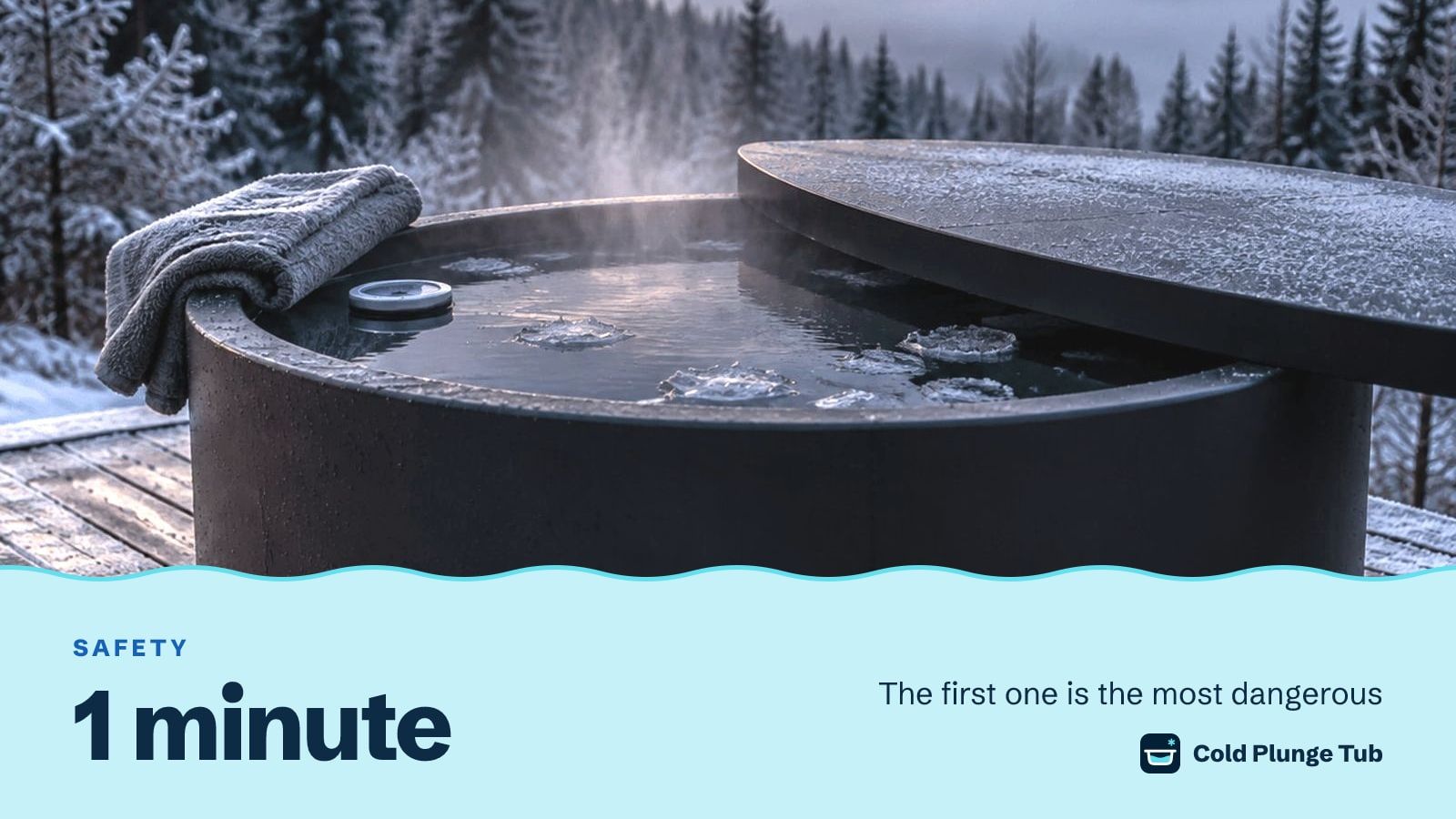
The most dangerous part of a cold plunge is the first 10 seconds to a minute, when cold shock makes you gasp and drives up your heart rate and blood pressure. The limits Cleveland Clinic gives for home are water no colder than 40°F and no more than five minutes.
For checking the water
All our tub picksCold plunge safety starts with cold shock
Cold plunge safety is mostly about one reflex. Cold shock is the body’s response to sudden cold water: an involuntary gasp, fast breathing you cannot slow down, and a jump in heart rate and blood pressure. American Heart Association News says it “can cause a person to drown within seconds if they involuntarily gasp while their head is submerged”.
It does not take icy water. The National Weather Service says cold shock “can be just as severe and dangerous from water temperatures of 50-60°F” as from water at 35°F. That is the range every guide on this site recommends, so the risk applies to an ordinary session and not only to a frozen lake.
- 10 sec to 1 min The most dangerous time
- 25 times How much faster water takes heat than air
- 40°F The coldest to go
- 5 minutes The longest to stay
The first two are from an American Heart Association News article, the first in the words of an exercise scientist it quotes. The limits are Cleveland Clinic’s.
We are not medical professionals. Everything here about the body is a medical source’s statement, named and linked, and where the sources differ we side with the most cautious. Timing and temperature have their own guides: how long to cold plunge and how cold an ice bath should be.
What cold water does to you, in order
| Stage | When | What happens | Source |
|---|---|---|---|
| Cold shock | The first two to three minutes | Gasping, rapid breathing, a spike in heart rate and blood pressure, and panic that “impairs clear thinking” | National Weather Service |
| Loss of strength | From the first seconds, and worse the longer you stay | Blood moves from the arms and legs to the core. Weak, numb hands and legs make it “difficult to exit the water safely” | National Weather Service, American Heart Association News, Cleveland Clinic |
| Hypothermia | With a long stay | Core temperature falls to 95°F or below. It gets “harder to think clearly or move well” | National Weather Service, American Heart Association News |
| After you get out | The minutes after | The risk of hypothermia continues until you are dry and warm | American Heart Association News |
The order matters for a tub at home. The gasp comes first, so the moment of getting in is the one to control. The weakness starts at once and builds, which is why you should get out while climbing out is still easy.
Who should not cold plunge without asking a doctor
Cleveland Clinic names eight conditions to raise with a healthcare provider first:
- Heart disease
- High blood pressure
- Diabetes
- Pregnancy
- Peripheral neuropathy
- Poor circulation
- Venous stasis
- Cold agglutinin disease
The heart comes first on that list for a reason. Cold water narrows the blood vessels, which raises blood pressure and makes the heart work harder. A preventive cardiologist quoted by American Heart Association News put it plainly: “I would caution against it for anyone with a cardiac history.” He added that medicines such as beta blockers, which lower heart rate and blood pressure, could make it harder for the body to adapt to the sudden cold.
Raynaud’s
Raynaud’s phenomenon narrows the blood vessels in the fingers and toes, and the National Institute of Arthritis and Musculoskeletal and Skin Diseases says cold is its most common trigger. Its example of a trigger is “grabbing hold of a glass of ice water”. A tub of 50°F water is a far bigger exposure than a glass. None of the sources we read says a cold plunge is safe with Raynaud’s, so ask the doctor who treats it.
Pregnancy
Cleveland Clinic lists pregnancy among the conditions to discuss first. No source we read gives a temperature or a time that is safe in pregnancy, so we give none.
The limits to keep at home
| Limit | The figure | Source |
|---|---|---|
| Water to start with | 50 to 59°F | Cleveland Clinic |
| Coldest water | 40°F | Cleveland Clinic |
| First sessions | One to two minutes | Cleveland Clinic |
| Longest session | Five minutes | Cleveland Clinic |
| Head | Out of the water | Our reading of American Heart Association News on gasping |
Keeping your head out is the cheapest safety measure there is. The gasp is involuntary. If your mouth is above the water when it happens, you breathe air.
Before every plunge
- Measure the water. Stir it, then read a thermometer. Ice melts unevenly and a tub can be colder than you think.
- Put a towel and warm clothes within reach. Mayo Clinic Health System says to keep them “close at hand” outdoors, because too long in the cold can lead to hypothermia.
- Tell someone. For your first sessions, have another adult in earshot.
- Set a timer you can see. Decide the time before you get in, not in the water.
- Get in slowly, feet first. Let your breathing settle before you sit down. Keep your head out.
- Get out at the time, or sooner. Lightheaded, breathing that will not settle, or anything that feels wrong means out. Cleveland Clinic’s physician: “Don’t try to push through what doesn’t feel right.”
- Dry off and dress. Cleveland Clinic says to dry off quickly and put on warm clothes.
The advice against plunging alone needs its context. The exercise scientist in the American Heart Association News article said “Never, ever do a cold water swim on your own”. He was talking about swimming in open water, where there is depth and distance. A tub you can stand up in is a smaller risk, and we have found no medical source that rules on it. Having someone nearby costs nothing while you learn how your body reacts.
His other advice carries over directly. Build up to it. He suggests “increasingly cooler showers or baths at home” before the real thing, which is also the cheapest way to find out whether you want a tub at all. How to cold plunge at home covers a first session.
The hazards that come with the tub
The medical sources write about the water. A tub at home adds a few risks of its own.
A chiller is a mains appliance beside water. The Consumer Product Safety Commission says ground-fault circuit interrupters belong “on all outdoor receptacles and receptacles within 20 feet of the water’s edge”, and that they should be tested monthly. That advice was written for pools, hot tubs and spas, and it reported 60 deaths in 13 years from electrical hazards around them. Plug a chiller into a GFCI outlet and nothing else. Outlet needs for each size are in chiller sizing.
A full tub is heavy. A gallon of water weighs 8.34 lb, so 100 gallons is 834 lb before the tub and you. That is our maths. Check a deck, a balcony or an upstairs floor before you fill it. Footprints and filled weights are in cold plunge tub dimensions.
Children and water. The federal Pool Safely campaign’s rule is “Always watch children when they’re in or near water, and never leave them unattended”, and it says to keep pool and spa covers in working order. A cold plunge tub holds enough water to drown in. Keep the lid on and fastened when nobody is using it.
Standing water. Water that sits for weeks needs a filter and a sanitiser. That is covered in cold plunge water care.
Is the risk worth it?
That depends on what you expect back, and the honest position is that the benefits are less settled than the risks. The same cardiologist said of cold water: “Whether there are health benefits or not is not clear and has not been established.” What the trials do and do not show is in cold plunge benefits.
For a healthy adult who keeps to 50°F and a couple of minutes, the sources describe a practice with known limits. Past those limits, or with one of the conditions above, they describe a risk.
Common questions
Can a cold plunge cause a heart attack?
Cold shock raises heart rate and blood pressure within seconds and makes the heart work harder, by American Heart Association News. The cardiologist it quotes cautions against cold plunging for anyone with a cardiac history. None of the sources we read puts a number on the risk.
Is it safe to cold plunge every day?
Mayo Clinic Health System says “You can do cold plunging every day”. It adds that daily plunges after training could hold back long-term gains. Cleveland Clinic’s five-minute limit applies to each session.
Can you get hypothermia from a cold plunge?
Yes, from staying in too long. Cleveland Clinic says prolonged exposure can lower your core temperature, and the National Weather Service puts hypothermia at a core temperature of 95°F. Water takes heat from the body 25 times faster than air.
Should you put your head under in a cold plunge?
We would not. The gasp reflex is involuntary and strongest in the first minute, and American Heart Association News says gasping with the head submerged can drown a person within seconds.
What should you do after a cold plunge?
Dry off quickly and put on warm clothes, by Cleveland Clinic. American Heart Association News adds that the risk of hypothermia continues after you get out.