Cold plunge filter and water care guide
A cold plunge filter keeps the water clear and a sanitiser keeps it safe. Which filter to fit, when to change it, and ozone, peroxide and chlorine compared.
Parts owners fit
- GE Whole House Water Filtration System (housing)Under $300See it on Amazon
- AquaChek Yellow 4-way pool and spa test strips, 50Under $300See it on Amazon
- Bartovation Hydrogen peroxide test strips, 0 to 100 ppm, 100-packUnder $300See it on Amazon
- Lamudo Ozone generator with Venturi injectorUnder $300See it on Amazon
The short answer
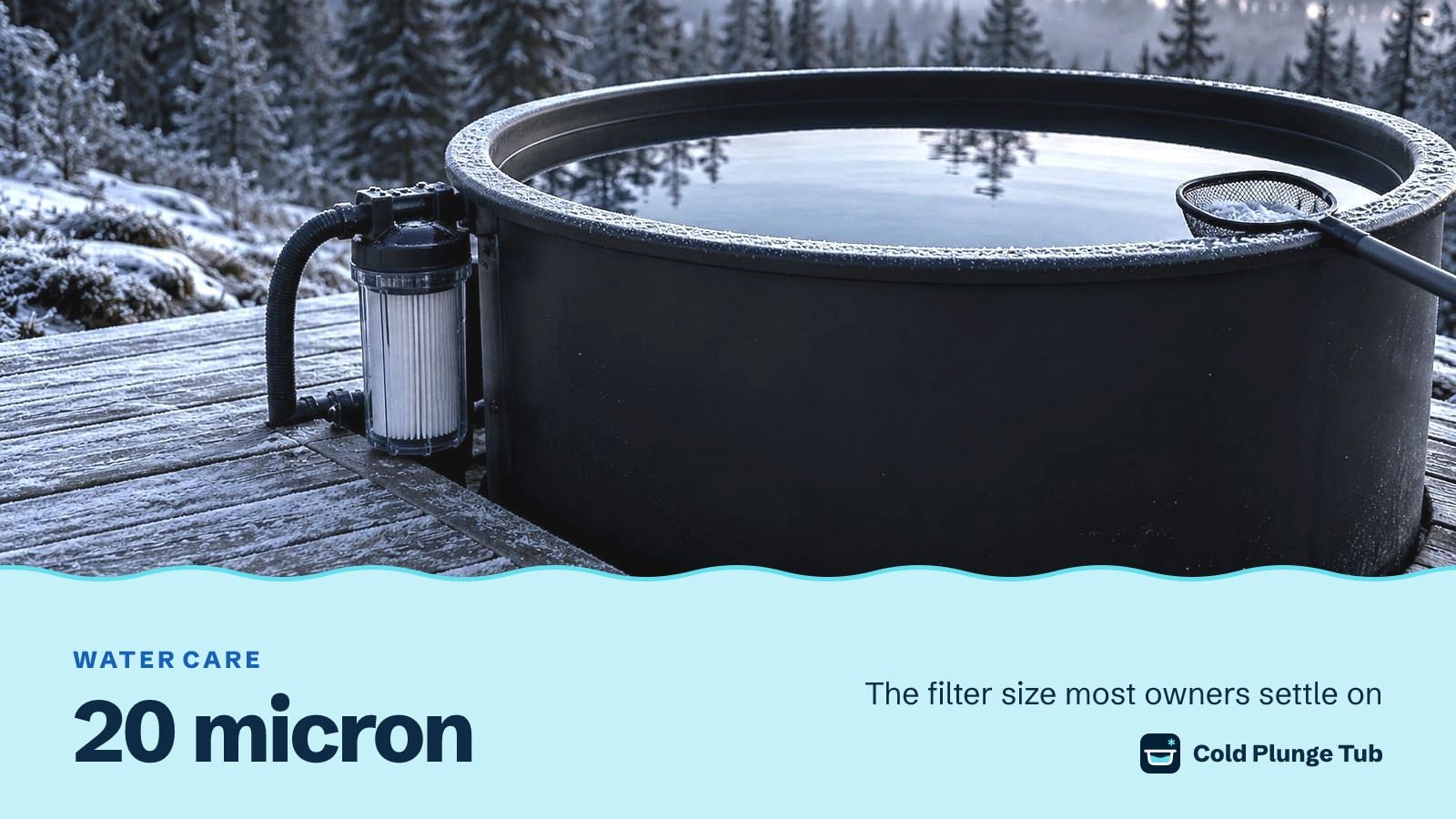
20 micron
That is the cold plunge filter most owners settle on: fine enough to catch grit and hair, coarse enough not to choke the pump. A filter clears the water. It does not kill anything, so pair it with a sanitiser and shower before you get in.
Parts owners fit
- GE Whole House Water Filtration System (housing)Under $300See it on Amazon
- AquaChek Yellow 4-way pool and spa test strips, 50Under $300See it on Amazon
- Bartovation Hydrogen peroxide test strips, 0 to 100 ppm, 100-packUnder $300See it on Amazon
- Lamudo Ozone generator with Venturi injectorUnder $300See it on Amazon
What keeps cold plunge water clean
A cold plunge filter is a cartridge the pump pushes water through to trap hair, skin and grit. It is one of four jobs, and owners on the r/coldplunge forum who keep the same water for months do all four.
| Job | What does it | What owners use |
|---|---|---|
| Keep dirt out | You | A soap-and-water shower before every plunge, and a lid |
| Move the water | A pump | Running all day, or on a timer |
| Filter it | A cartridge | A 20-micron cartridge in a whole-house filter housing |
| Sanitise it | Something that kills bacteria | Ozone, hydrogen peroxide, chlorine or bromine |
The shower comes up more than any product. A technician who maintains cold plunges for a living calls it “the single most impactful thing you can do”, because skin oil, sweat and sunscreen are what bacteria feed on.
We have not tested any of this. The chlorine and pH figures are the CDC’s, the ozone warning is the EPA’s, the filter sizes are makers’ specs, and the routines are owners’ own.
Which cold plunge filter to buy
Buy by micron rating, the size of particle the cartridge stops. Owners have tried the range.
| Micron rating | What owners report |
|---|---|
| 1 | Clogs within weeks and slows the flow |
| 5 | Works. Rinse every two weeks and replace about monthly. One owner’s “flow got killed pretty quick” |
| 20 | “The right balance between filtering out debris and maintaining consistent water flow” |
| 50 | Lasts about three months in a clean indoor setup |
Makers land in the same place. The Pod Company, AS ColdPlunge and 1stplunge all state a 20-micron filter for their chillers, and TURBRO states a 40 and a 20 micron pair.
Two more things from owners. Pleated cartridges hold up, and string-wound ones “start to fall apart” after a few weeks in cold water. And a cartridge filter needs a housing: the builds in our DIY cold plunge chiller guide use a whole-house filter housing from a hardware store.
A chiller with a built-in filter needs none of this. Its maker sells the cartridges, and our best cold plunge chillers says which type each one takes.
How to change the filter on a cold plunge
- Switch off the pump and the chiller.
- Close the valves on both sides of the filter, if your build has them. Without valves, expect to lose water.
- Unscrew the housing over a bucket and lift out the cartridge.
- Rinse it with a hose, or fit a new one if it will not come clean.
- Refit the housing, open the valves and start the pump.
- Check for drips and check that the flow is back.
How often is where owners differ, and it tracks how dirty the water gets.
- Rinse every one to two weeks. Several owners do this and stretch a cartridge to a month or more.
- Replace every one to three months. A technician’s range is three to six months with monthly rinsing.
- Replace sooner if the flow drops. A blocked filter is also the first thing to check when a chiller stops cooling.
The cartridges are cheap. The Pod Company sells a four-pack for $39 and TURBRO a five-pack for $39.99, on their own sites.
Ozone, peroxide or chlorine?
A sanitiser is what kills bacteria, and there is no agreed answer among owners. Here is what each one is and what is known about it.
| Sanitiser | How owners use it | What to know |
|---|---|---|
| Hydrogen peroxide | A few ounces of 3% a week, or dosed to a test strip | The most common choice. The doses owners quote vary widely |
| Ozone | A generator on a timer, 30 minutes to 3 hours a day | Nothing to add by hand. Harmful to breathe |
| Chlorine or bleach | A small tablet, or a capful of bleach after a plunge | The one sanitiser with a public health figure behind it |
| Bromine | A teaspoon after a fill, tested weekly | Used in hot tubs. One owner says The Pod Company’s site tells you not to use it |
| UV light | A lamp in the plumbing | Owners pair it with a filter, and say it works best on filtered, clear water |
The CDC gives figures for home pools and hot tubs: a pH of 7.0 to 7.8, and chlorine of at least 1 part per million in a pool and 3 in a hot tub. It adds that chlorine kills germs less well as pH rises, “especially if pH is >8.0”. The CDC has no page for cold plunges, and we found no equivalent public health figure for peroxide or ozone on their own.
That gap matters for one reason. Clear water is not the same as clean water. An owner whose water has stayed clear for months on peroxide and ozone may be right that it is fine, and has no number to check it against. If you want one, chlorine and a test strip give you the CDC’s.
One owner’s experience cuts the other way. After months of bottled treatments and peroxide, with water turning foggy inside a week, they stopped adding anything and ran a 5-micron filter around the clock. The water then stayed clear for weeks. More product is not always the fix.
Ozone generator for a cold plunge
An ozone generator makes ozone gas and feeds it into the water. Owners describe it as a strong oxidiser. Owners like it because it runs on a timer and needs nothing bought or poured.
How owners set it up:
- On a timer. Runs of 30 minutes, an hour, 90 minutes and three hours a day all appear in the threads, usually at night.
- Through a Venturi injector, which draws the gas into the water line, with a one-way valve so water cannot run back into the generator.
- On the return, after the chiller. The order is in our DIY cold plunge chiller guide.
Two cautions from single commenters. One says ozone can corrode a galvanised stock tank and degrade rubber parts. Another notes that it turns clear vinyl tubing cloudy.
How often to change the water
| Setup | How long the water lasts | Who says so |
|---|---|---|
| No filter, no sanitiser | 3 to 5 days | A cold plunge technician |
| No filter, shower first, a little peroxide | 2 to 3 weeks | Several owners of soft pods |
| Filter and a sanitiser | 6 to 8 weeks | A technician, and one owner |
| Chiller with filter | Four weeks or more | The Pod Company, of its own chiller |
| Filter, ozone and a sanitiser | 3 to 6 months | Several owners |
The best advice in the threads is to “change on the test strip, not the calendar”. If the water tests in range and stays clear, there is no reason to dump it. Change it when it turns cloudy, smells, or will not come back into range.
Fresh water costs ice. Every refill starts warm again, which is one more reason regular plungers move to a chiller. The sums are in how much ice an ice bath needs.
How to clean a cold plunge tub
The slippery film on the walls is biofilm, and owners say it forms even in water that looks clean.
- Wipe the walls weekly with a microfibre cloth. One owner puts a little 3% hydrogen peroxide on it.
- Scrub when you drain. A non-abrasive pad, the white kind, so you do not scratch the surface.
- Do the lid seal and the corners. One owner points out that the gasket and the spots the pump does not reach are where biofilm hides.
- Rinse the filter while the tub is empty.
A portable ice bath with no pump gets the same treatment more often. Owners of soft pods shower first, keep the lid on and change the water every two to three weeks. Some makers sell a kit for this: Ice Barrel lists one with cleaning soap, a stabiliser, a brush and a net.
What you need
A filter housing and cartridges if your chiller has no filter, a sanitiser, and test strips that read whatever you use: chlorine and pH strips for chlorine, peroxide strips for peroxide. Both kinds are in the list beside this page. A chiller with the filter built in covers the first of those, and our picks are in the best cold plunge chillers.
Common questions
Do I need a filter for a cold plunge?
Not if you change the water every week or two. To keep water longer than that, yes. A filter needs a pump, so it usually arrives with a chiller.
Can I use chlorine in a cold plunge?
Owners do, and it is the sanitiser the CDC gives home figures for. Check your tub’s and chiller’s manual first, since some makers rule out particular chemicals.
How much hydrogen peroxide do I put in a cold plunge?
There is no agreed dose. Owners quote anything from two ounces of 3% a week to a cup, and one doses to 30 to 50 parts per million on a test strip. Follow your chiller maker’s guidance if it gives any.
Does cold water stop bacteria growing?
It slows them, by a technician’s account, and owners with cold water still report biofilm. Cold alone is not a sanitiser.