When to cold plunge: before or after?
When to cold plunge depends on your training. After endurance work it helps soreness. Within four hours of lifting it can cost you muscle. What the sources say.
For timing a session
All our tub picksThe short answer
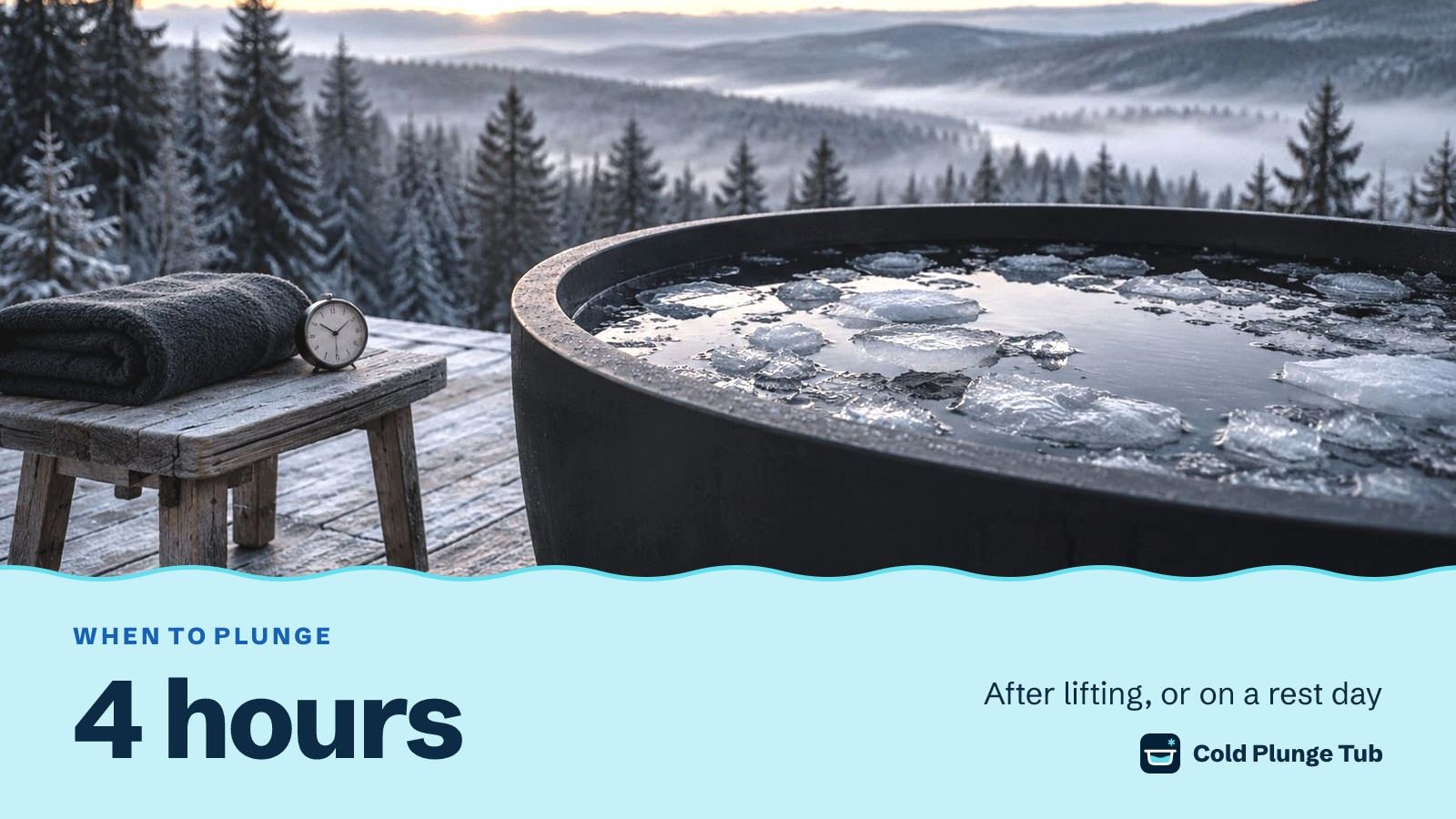
4 hours after lifting
Or on a rest day. If you train for strength or size, keep cold water away from the hours after a session. After a run, a ride or a hard game, plunge when you finish. For mood or habit, any time you will stick to.
For timing a session
All our tub picksWhen to cold plunge, by what you train for
A cold plunge is a few minutes in cold water, usually 50 to 59°F. When to take it depends on one question: are you trying to recover from today’s session, or build on it?
| Your goal | When to cold plunge | Why | Source |
|---|---|---|---|
| Less soreness after hard exercise | Soon after you finish | Cold water reduces muscle damage and soreness and helps restore performance the next day | Mayo Clinic Health System, and a review of nine trials |
| Strength or muscle growth | On rest days, or more than four hours after training | Cold can turn down the signals that make muscle grow | Cleveland Clinic, Mayo Clinic Health System, a 12-week trial |
| Endurance training | After training is fine | Cold “doesn’t appear to negatively affect endurance training in the same way” | Mayo Clinic Health System |
| Mood, alertness or the habit itself | Any time | Neither clinic names a time of day | None |
We are not medical professionals. Everything here comes from the two clinics and the two studies named, and we say where they stop.
Before or after a workout?
After, if you are plunging for recovery. Mayo Clinic Health System says research has found that cold water immersion “helps reduce the degree of exercise-induced muscle damage”, which means less inflammation and less soreness the next day. A review of nine trials found it slightly better than resting for muscle soreness.
Not straight after, if you are lifting to get stronger.
Plunge soon after training if
You run, cycle, swim or play a sport, and you need to be ready again tomorrow. Soreness is the problem you are solving.
Wait four hours, or use a rest day, if
You lift for strength or size. Mayo Clinic Health System says cold water may turn down the signalling that normally follows a session.
The four hours is Cleveland Clinic’s. Its sports medicine physician says, “If not timed right, cold therapy can interfere with muscle gains”, and puts the risk in the four hours after a workout. Plunging on rest days between sessions is fine.
The trial behind the warning
In a study in The Journal of Physiology, 21 active men strength trained twice a week for 12 weeks. After every session, half sat in cold water for 10 minutes and half did light exercise instead.
- 21 men In the trial
- 12 weeks Of strength training
- 10 minutes In cold water after each session
- 17% Growth in fast-twitch fibre size without the cold
Roberts and others, 2015. The 17% is the group that did light exercise. The cold water group showed no significant increase.
Strength and muscle mass rose more in the group that skipped the cold water. The authors’ conclusion was blunt: cold water immersion “as a regular post-exercise recovery strategy should be reconsidered”. Mayo Clinic Health System makes the same point for everyday plungers. You can plunge daily, but “if you’re doing it after training, daily plunges could compromise the potential for long-term performance improvements”.
That is one small trial in physically active men, with the plunge straight after every session. It does not say cold water makes you weaker. It says not to put it right after the lifting you want to grow from.
Morning or night?
Neither clinic gives a time of day, and we found no trial in these sources that compares them. So this one is yours to decide. Pick the time you will keep to.
If you lift in the evening, that settles it: plunge in the morning.
Cold plunge or hot tub first?
No medical source we read sets an order for heat and cold. The one sequence Cleveland Clinic mentions is heat after cold: dry off, put on warm clothes, and you “may even want to try sauna therapy after taking a cold plunge”.
That order has one practical point in its favour. You finish warm, which matters most outdoors in winter. Going from hot water into cold is common too, and if you do it, treat the cold part by its own rules: 50 to 59°F, a minute or two, out if you feel lightheaded.
How often to cold plunge
Start with once or twice a week. That is Cleveland Clinic’s advice for beginners: “Start slow and see what your body can tolerate before staying in longer.”
There is no stated upper limit. Mayo Clinic Health System says “you can do cold plunging every day”, with the training caveat above. How long each session should last is in our guide to how long to cold plunge, and the water temperature is in how cold an ice bath should be.
When not to cold plunge
- In open water with a current. Mayo Clinic Health System warns against rivers, where you can be swept downstream or trapped under ice.
- When something feels wrong. Cleveland Clinic’s physician says to get out if you feel lightheaded or anything beyond cold: “Don’t try to push through what doesn’t feel right.”
- When you have nothing warm to put on. Too long in the cold can lead to hypothermia, and Mayo Clinic Health System says to keep towels and warm clothing close.
What you need to do it on a schedule
Timing only works if the water is cold when you are ready. With ice, that means buying and adding it before each session. With a chiller, the tub is at temperature whenever your rest day comes round. Our picks for both are in the best cold plunge tubs and the best cold plunge chillers.
Common questions
Should I cold plunge before a workout?
The sources here only cover plunging after exercise. None of them recommends it beforehand.
Can I cold plunge every day?
Yes, by Mayo Clinic Health System. If you also strength train, keep the plunge off the hours after your sessions.
How long after lifting should I wait to cold plunge?
More than four hours, by Cleveland Clinic. A rest day is simpler.
Does a cold plunge help after running?
It can. Mayo Clinic Health System says cold water reduces soreness after hard exercise, and that it does not seem to hold back endurance training the way it can strength training.