Cold plunge vs ice bath: same thing?
Cold plunge vs ice bath: both mean sitting in cold water, usually at 50 to 59°F. What differs is how the water gets cold, how steady it stays and what it costs.
The short answer
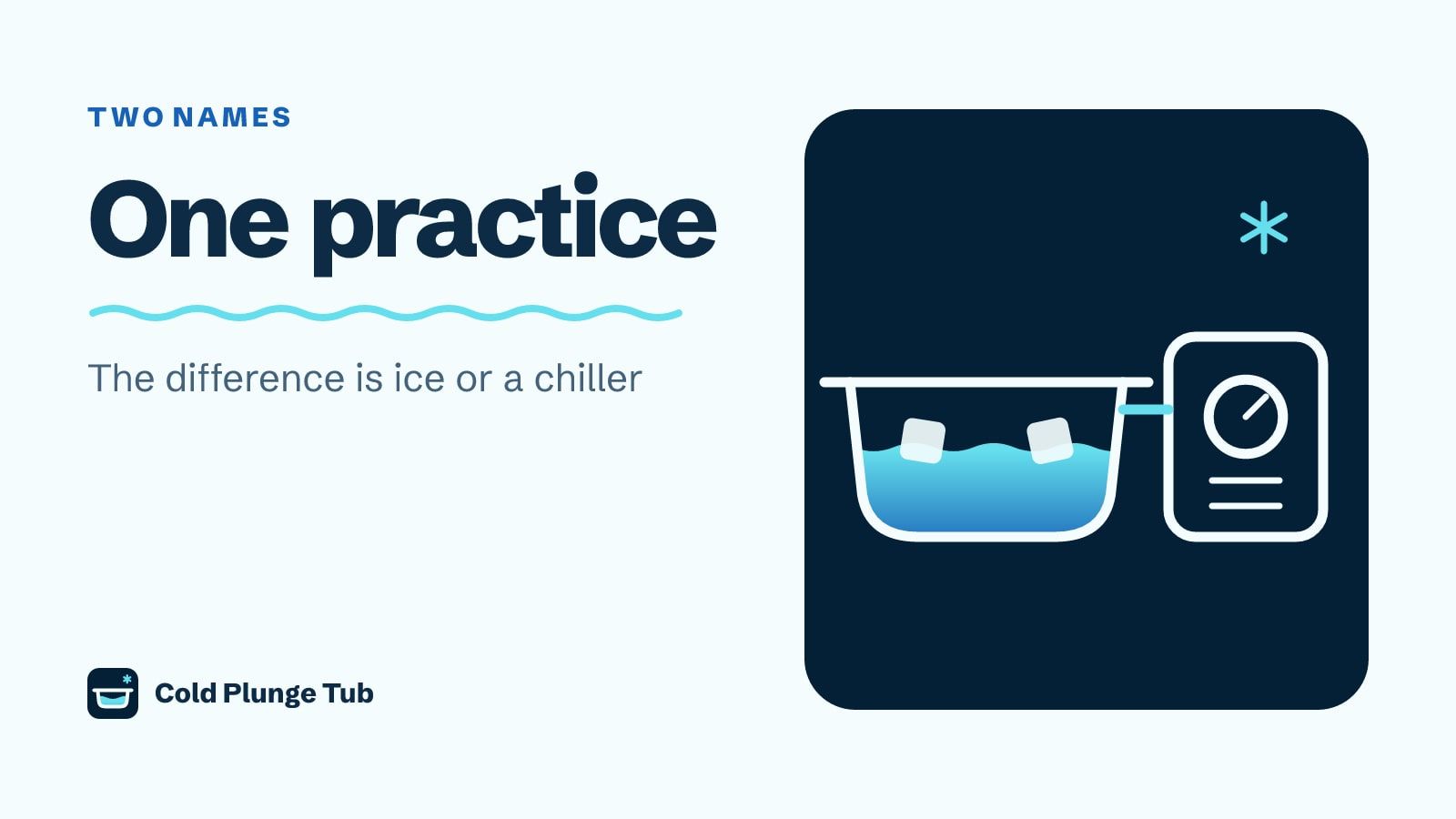
A cold plunge and an ice bath are the same practice: sitting in cold water for a few minutes. In everyday use, “ice bath” means a tub you cool with ice, and “cold plunge” means a tub that holds a set temperature, often with a chiller.
Cold plunge vs ice bath: two names, one practice
Both words describe cold water immersion. You lower yourself into cold water up to the chest or shoulders, stay a few minutes, and get out. Cleveland Clinic defines a cold plunge as “a dip into an icy bath” and treats cold plunge, cold therapy and cold-water immersion as names for one thing.
So the argument over cold plunge vs ice bath is mostly about vocabulary. In the US, “cold plunge” is the more common of the two. People search for it about three times as often as “ice bath”. This site uses both, and so do the shops.
The numbers below hold whichever word you use. Our guide to cold plunge temperature goes through them in detail.
- 50–59°F Water temperature for beginners
- 1–2 minutes A first session
- 5 minutes The most to stay in
- 40°F Don’t go colder than this
Figures from Cleveland Clinic, sports medicine physician Dominic King, DO.
Where the two words part ways
Shops and owners do use the words differently, and the difference is the equipment. An ice bath gets cold because you tip ice into it. A cold plunge, in the sense a shop means it, stays cold by itself.
| Ice bath | Cold plunge with a chiller | |
|---|---|---|
| How the water gets cold | Bags of ice, every session | A chiller, a refrigeration unit that cools and circulates the water |
| Temperature | Coldest at the start, then warms as the ice melts | Holds the number you set |
| Cost up front | Low. Any tub that holds water works | High. The chiller often costs more than the tub |
| Cost per session | The ice | Electricity |
| Getting ready | Buy ice, fill, wait | Lift the lid |
| The water | Usually drained and refilled | Kept in the tub and filtered |
The ice adds up faster than most people expect. Cooling 100 gallons from 60°F to 50°F takes roughly 51 lb of ice, and that is before the air and the tub walls warm the water back up. Our guide to how much ice you need has the full table.
Your body can’t tell them apart
Water at 52°F is water at 52°F. Nothing about the name on the tub changes what the cold does to you, so the two things that matter are the temperature and how long you stay in.
That cuts both ways. The risks are the same too.
The first minute is the dangerous one. Getting into cold water sets off the cold shock response, which the American Heart Association describes as “a sudden, rapid increase in breathing, heart rate and blood pressure”. It happens in an ice bath and in a $5,000 cold plunge alike, and it is why you get in slowly and keep your head above the water.
Cleveland Clinic lists hypothermia, breathing difficulty, strain on the heart, and numbness with loss of motor control, and it advises against cold plunging for people with heart disease, high blood pressure, diabetes, poor circulation or peripheral neuropathy, and during pregnancy.
One real difference does follow from the equipment. An ice bath is at its coldest in the first minutes, when you are least used to it. A chilled tub is the same temperature at minute one and minute four, which makes it easier to repeat a session and to work down a few degrees over several weeks.
Which one to start with
Start with ice. You don’t yet know whether you will still be doing this in two months, and a tub with a few bags of ice answers that question for very little money.
Start with an ice bath if
You are trying cold plunging for the first time, you will plunge once or twice a week, or you have nowhere to leave a tub plugged in.
Buy a chiller if
You plunge most days, you are tired of buying ice, or you want the water at the same temperature every time. See the best cold plunge chillers.
The first-year sums for each route are in what a cold plunge costs.
The mistake to avoid is buying the wrong tub first. Our picks, with and without chiller fittings, are in the best cold plunge tubs. If there is any chance you will add a chiller, pick an ice tub with a chiller fitting, so the upgrade is a new box beside the tub and not a new tub.
Cold tub, polar plunge, cold shower
A few neighbouring terms come up in the same searches.
- Cold tub and ice tub are other names for a cold plunge tub.
- Polar plunge is a one-off dip in open water in winter, usually a lake or the sea. It is an event, and the water is not controlled.
- Cold shower is cold water over the body, not immersion in it. It is the cheapest way to find out how you react to cold before buying anything.
Common questions
Is an ice bath colder than a cold plunge?
Not by definition. An ice bath can start colder, because ice water sits near freezing where the ice is, but it warms through the session. A cold plunge with a chiller stays at the temperature you set. Either one can be anywhere in the 40 to 59°F range.
Can I use my bathtub as a cold plunge?
Yes. Fill it with cold tap water and add ice until a thermometer reads between 50 and 59°F. It works for finding out whether you like it. The drawbacks are that a bathtub is shallow, so covering your shoulders means lying back, and you buy ice every time.
Do I need ice at all?
Only if your water is warmer than you want it. If your cold tap already runs in the 50s, a tub of tap water is a cold plunge. A chiller removes the need for ice altogether.
How long should I stay in?
Cleveland Clinic suggests one to two minutes when you are starting out, and never more than five. Longer is not better, and the same limits apply to an ice bath and a cold plunge.